Skip to next paragraph

Agence France-Presse-Getty Images
Karel Appel with one of his sculptures in 1993 at the Palace Lange Voorhout in The Hague. Mr. Appel turned to sculpture in his later years.
Karel Appel with one of his sculptures in 1993 at the Palace Lange Voorhout in The Hague. Mr. Appel turned to sculpture in his later years.
Mr. Appel's death was announced by the Karel Appel Foundation in the Netherlands. No cause was given, though Mr. Appel apparently suffered from a heart ailment, The Associated Press reported on Friday.
Information on survivors could not immediately be confirmed.
With several colleagues, including the Danish artist Asger Jorn and the Belgian artist known as Corneille, Mr. Appel founded Cobra in 1948 at an international conference in Paris. The movement's original name was Reflex, but it came to be called Cobra, an acronym for Copenhagen, Brussels and Amsterdam, the cities from which its founders came.
The Cobra aesthetic — abstract, spontaneous, expressionistic, riotous with color — was a shot across the bow of de Stijl, which then dominated Dutch art with its rigid insistence on geometric form. It was also a reaction against the hegemony of French Surrealism.
Cobra was short-lived; its members exhibited together only through the early 1950's. But their work is often credited with rejuvenating Dutch modern art in the postwar period and has had enduring importance in the years since.
Writing in The New York Times in 1981, Helen A. Harrison said that Cobra's major achievement "was in fostering an amalgam of aspects of the major trends in contemporary artistic thinking" with "the dark, mystical Northern sensibility that gives their work its peculiar character, so appropriate to postwar Europe."
She added: "In short, they seem to have been able to express both optimism and anxiety at the same time."
The Cobra artists considered painting to be a window onto the human psyche, and their art often displayed a primal, almost childlike vitality. Mr. Appel was no exception: in his best-known work he laid on saturated color with such thick, sweeping strokes that the canvases became sculptural, almost alive. (His paintings were often likened to the work of Willem de Kooning.)
Some critics discerned violence or even madness in Mr. Appel's work, with its liberal use of red and its semi-figurative images of grotesque limbs and distorted, grimacing faces. But to other viewers, the unrestrained masses of paint, which Mr. Appel sometimes squeezed onto the canvas straight from the tube, embodied the life force itself.
In later years, Mr. Appel turned to actual sculpture, producing works of painted wood and colorful rigid polyester. Still later sculptures were of aluminum, with parts that could be moved. As he described them in an interview quoted in the reference work Contemporary Artists: "I hinge the ears so that you can play with them, and they move in the wind as well, which changes the whole shape of the sculpture. The toy principle, you know."
Karel Christian Appel was born in Amsterdam on April 25, 1921, and studied at the Royal Academy of Fine Arts there. His early influences included Picasso, Matisse and Jean Dubuffet. In 1950, Mr. Appel moved to Paris, and in 1953 was given a solo show at the Palais de Beaux-Arts in Brussels. He was awarded the Unesco Prize at the Venice Biennale the next year.
Mr. Appel later lived in New York and Italy before settling in Switzerland. His work has been exhibited in major museums around the world, among them the Museum of Modern Art, the Guggenheim Museum, the Museum of Fine Arts in Boston and the Tate Gallery in London.
In an oral history quoted in Contemporary Artists, Mr. Appel described the wild artistic urgency that gave rise to Cobra:
"The Cobra group started new, and first of all we threw away all these things we had known and started afresh, like a child — fresh and new. Sometimes my works look very childish, or childlike, schizophrenic or stupid, you know. But that was the good thing for me. Because, for me, the material is the paint itself. The paint expresses itself. In the mass of paint, I find my imagination and go on to paint it."
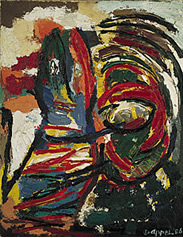
Karel Appel: The Crying Crocodile Tries to Catch the Sun
Guggenheim Museum (Guggenheim Museumwww.guggenheim.org)
© 2005 Karel Appel Foundation/Artists Rights Society (ARS) New York/Beeldrecht, Amsterdam
The dynamic pictorial panorama of the second half of the 20 th century had a lot of protagonists, but very few of them reached such prominence as Karel Appel's had
As many others artists of its generation, Appel suffered the tragedy of the World War Two, which had a considerable influence –in a conscious or unconscious way- in all his artistic oeuvre . A native from Amsterdam , Appel was forced to leave the city to avoid be arrested by the occupying Nazis in 1944. Shortly afterwards, he returned to the Dutch capital to take part in an exhibition of young artists in the Stedelijk Museum .
THE NUDE BRUSHSTROKE
The nude brushstroke, that's what I search , Appel said in his first years. With his emaciated figures and bright -often disturbing- colours, Appel´s paintings were not well accepted by a criticism still used to the geometric abstraction of his countryman Pietr Mondrian.
Nevertheless, Appel's interests and his eagerness to recover the primitivism as engine of the artistic expression were shared by many of his young contemporaries, and in 1948, when he was only 27 years old, Appel take part of the founder group of an artistic movement that played a highly important role in the artistic evolution in Europe in the second half of the 20 th Century: The Cobra Group.
AN ANIMAL, A NIGHT, A SCREAM, A HUMAN BEING, A WHOLE THE COBRA GROUP
Founded in 1948 as an answer to the geometric abstraction, the Cobra Group (named with the first letters of the native cities of its members – Copenhagen , Brussels and Amsterdam- ) had such famous members as PIERRE ALECHINSKY (1927), AGER JORN (1914-1973), CORNEILLE (Cornelis van Beverloo, 1922) or Appel himself. Their art were characterized by spontaneous, vitalistic and impulsive brushstrokes, demanding a complete artistic freedom. The same Appel declared thatI paint like a lout in this lout times�? . The huge mural created in 1949 in the Amsterdam City Hall caused an enormous controversy and was covered up for nearly a decade.
In the early 50s, Appel reached the zenith of his Art, with his devious pictures of human beings and animals of vivid colours, violent foreshortenings and no evidence of perspective.
LAST YEARS
Nevertheless, in the following years Appel developed his painting into the figuration or even the abstraction. In the late sixties, he dealt with artistic fields such as the sculpture or the illustration. However, he never abandoned the human figure as a reference in his creations.
Karel Appel died on the 3 rd of May 2006, and was buried in the Père Lachaise Cemetery in Paris , along with other famous artists as Oscar Wilde, Theodore Gericault and Jim Morrison.

